 Rhea
Rhea lets you choose an xRHEA cooldown before withdrawing RHEA
Rhea lets you unstake xRHEA into RHEA through an exit with a selected cooldown. The assets awaiting release earn no staking yield during that interval. Available exit choices determine the delay and any unstaking fee. A farming or lending boost lock can also affect which xRHEA is available to redeem. Plan around the terms attached to the selected amount, keeping expected RHEA proceeds separate from the balance available for withdrawal.
· updated
In short: Assets awaiting release from an xRHEA unstake earn no staking yield, so a longer cooldown lengthens the interval without staking earnings.
Keeping a stake, starting an exit or adding a boost lock
Keeping xRHEA staked preserves the staking position, while unstaking begins its conversion back into accessible RHEA. Locking xRHEA for a boost commits it to an incentive program. These choices have different timing constraints, even when an interface presents them near each other. A boost lock rewards a period of commitment; an exit cooldown governs access to the unstaked asset.
| Choice | Reward treatment | Time commitment | Access to RHEA |
|---|---|---|---|
| Keep xRHEA staked | Eligible for staking yield | No exit requested | Requires an unstaking choice |
| Begin delayed unstaking | No staking yield during cooldown | Selected exit cooldown | Available after the cooldown |
| Lock xRHEA for a boost | Boosts eligible farm or lending incentives | Selected boost lock | Lock terms govern the committed xRHEA |
| A boost lock and an unstaking cooldown govern different commitments and should not share an assumed end date. | |||
Reading the exchange rate in RHEA per xRHEA
The exchange rate expresses the RHEA value of each xRHEA unit, so the input and output amounts use different tokens. Staking creates an xRHEA position from RHEA. Unstaking reverses that relationship under the applicable exit terms. Matching the token units matters when comparing the amount entered with the expected proceeds.
The input and the expected proceeds
xRHEA selected for redemption
The unstaking amount refers to xRHEA, the token representing the stake. It does not directly specify an equal number of RHEA tokens. The conversion rate connects those quantities. A changing rate can therefore change the corresponding RHEA amount without changing the number of xRHEA units selected.
RHEA shown after conversion
The expected output and estimated fee belong to the proposed exit. Read both alongside the selected cooldown. An exchange-rate calculation explains a token quantity; it does not establish withdrawal eligibility or prove the wallet has received the tokens. Check whether the displayed output already accounts for that charge before estimating the RHEA proceeds.
When does the xRHEA cooldown start?
The cooldown applies upon unstaking, so time already spent holding xRHEA does not replace the selected exit wait. Preparing an amount or choosing a period describes a proposed action. The relevant waiting period belongs to the unstaking operation the protocol accepts.
Choose the offered period before committing to the exit. Closing a form or disconnecting a wallet does not reverse an accepted blockchain operation. Plan from the terms of the actual unstake, without assuming a submitted request retains the editable settings of its preparation screen.
Staking yield stops for the assets entering cooldown
Assets in an xRHEA unstaking cooldown do not accrue staking yield. The waiting period therefore creates an interval between leaving active staking and gaining access to RHEA. A longer delay extends that interval. The yield pause applies to the assets entering cooldown.
The displayed APY, or annual percentage yield, describes the return measure for active staking. It does not specify the RHEA proceeds of an exit. For withdrawal planning, the selected waiting period and any exit charge answer different questions from the return displayed for an active stake.
Farming and lending boost locks have their own purpose
A boost lock commits xRHEA to increasing eligible incentive rewards, while an unstaking cooldown concerns its return to RHEA. The lock attached to a boost position matters before planning redemption. Its duration does not become an interchangeable setting on the ordinary unstaking form.
Farming weight and the reward multiplier
The farming boost calculates weight from the amount of xRHEA locked and the chosen duration. A separate multiplier then uses that weight to adjust the share of incentive rewards. Weight and the reward multiplier are different quantities. A weight increase should not be read as an identical increase in farm yield or as additional RHEA available for withdrawal.
Lending incentives and base interest
The lending boost also uses locked xRHEA to increase the share of incentive rewards. It does not change the base lending interest rate. Borrowing obligations belong to the lending position, while redemption concerns the staked token.
A boost multiplier describes reward allocation. It does not specify an xRHEA unlock date.
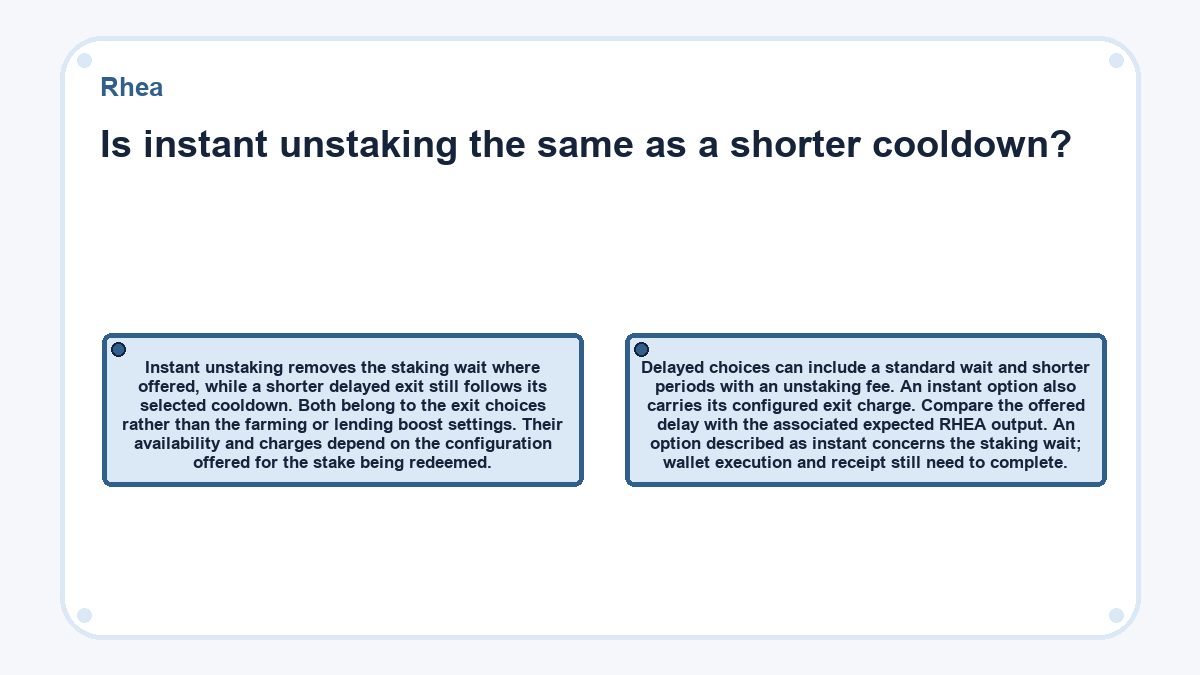
Is instant unstaking the same as a shorter cooldown?
Instant unstaking removes the staking wait where offered, while a shorter delayed exit still follows its selected cooldown.
Both belong to the exit choices rather than the farming or lending boost settings. Their availability and charges depend on the configuration offered for the stake being redeemed. Delayed choices can include a standard wait and shorter periods with an unstaking fee. An instant option also carries its configured exit charge. Compare the offered delay with the associated expected RHEA output. An option described as instant concerns the staking wait; wallet execution and receipt still need to complete.
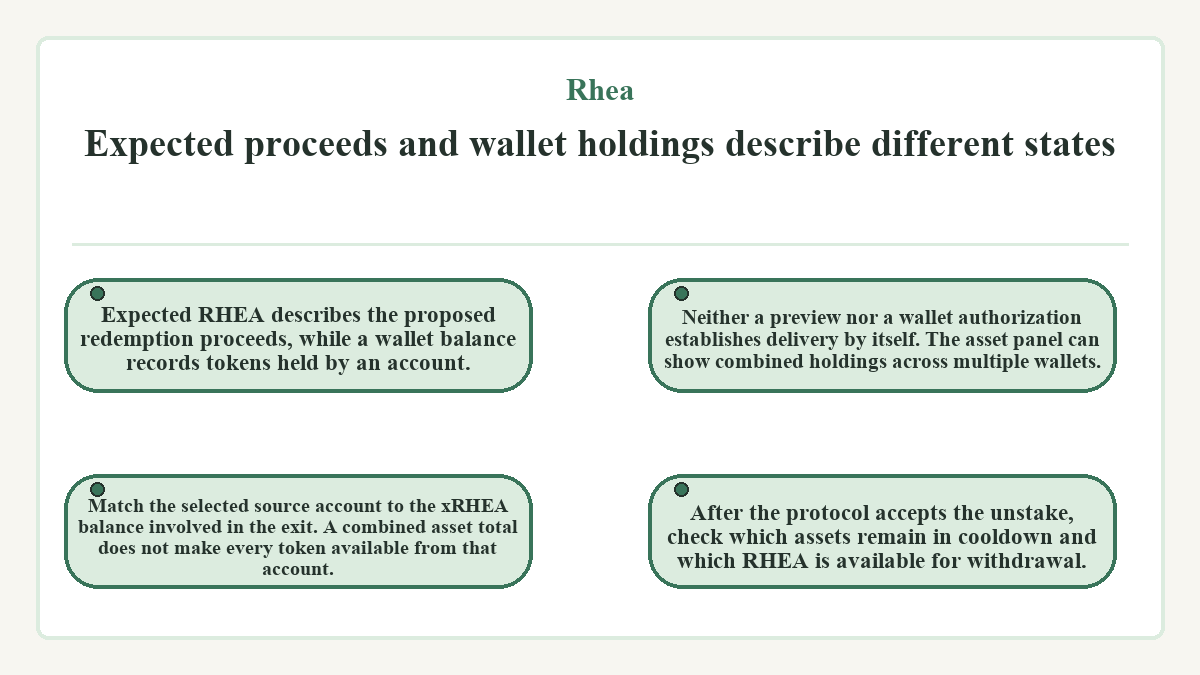
Expected proceeds and wallet holdings describe different states
Expected RHEA describes the proposed redemption proceeds, while a wallet balance records tokens held by an account. Neither a preview nor a wallet authorization establishes delivery by itself. The asset panel can show combined holdings across multiple wallets.
Match the selected source account to the xRHEA balance involved in the exit. A combined asset total does not make every token available from that account. After the protocol accepts the unstake, check which assets remain in cooldown and which RHEA is available for withdrawal.
Redeeming xRHEA and closing other positions
Redeeming xRHEA concerns the RHEA staking position; removing liquidity concerns pool shares and their underlying tokens. Repayment addresses a borrowed asset and its outstanding obligation. The cooldown attached to a staking exit does not supply a universal withdrawal schedule for liquidity pools or borrowing positions.
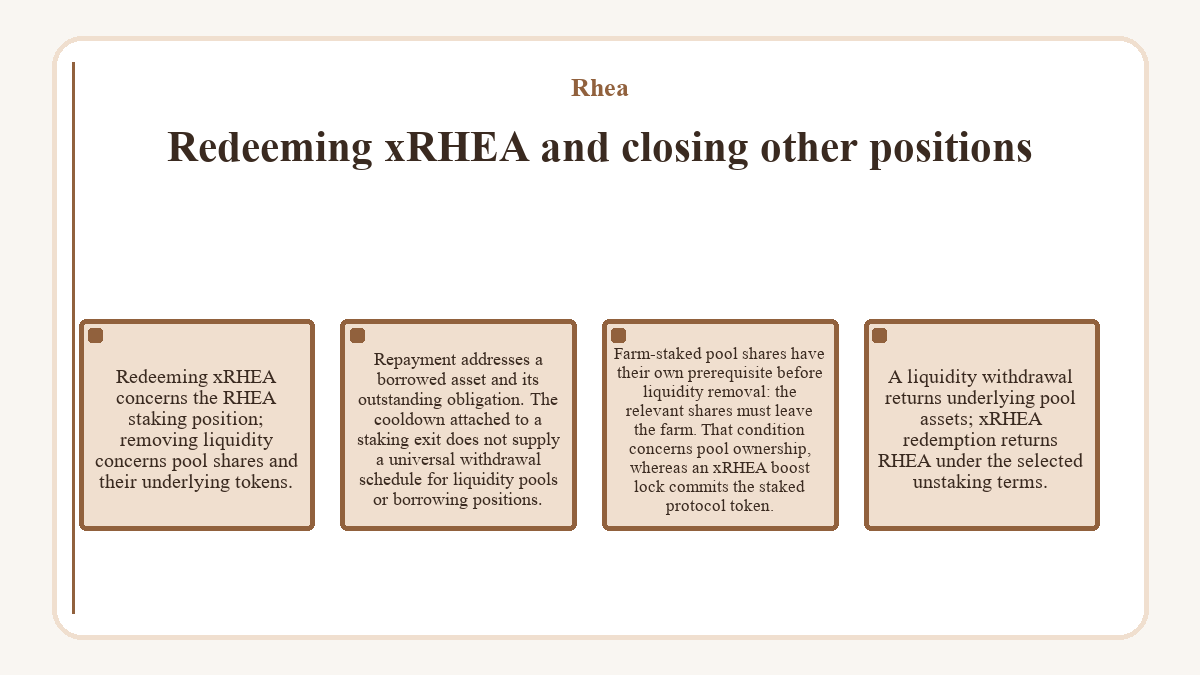
Farm-staked pool shares have their own prerequisite before liquidity removal: the relevant shares must leave the farm. That condition concerns pool ownership, whereas an xRHEA boost lock commits the staked protocol token. A liquidity withdrawal returns underlying pool assets; xRHEA redemption returns RHEA under the selected unstaking terms.
Questions people ask about Rhea
Do I have to unstake my entire xRHEA balance?
The unstaking form supports a selected xRHEA amount, so an exit does not have to use the entire displayed balance. Its amount controls include a HALF option as well as MAX. Choose an amount available to the source account; a total across wallets or a balance committed to a boost lock does not establish how much that account can redeem.
Can I receive a different token by unstaking xRHEA?
The xRHEA redemption described here has RHEA as its output token. Obtaining another asset involves an additional supported conversion, with its own execution terms. Do not interpret the expected RHEA amount as a quote for a different token or as proof of delivery to another network. Check the output token and destination before confirming the exit.
Are an unstaking fee and a blockchain transaction fee the same charge?
An unstaking fee concerns the chosen redemption option, while a blockchain transaction fee pays for executing an operation on the network. Their purposes differ even when a wallet presents charges together. Compare the exit estimate with the wallet's execution details before authorizing the action. The delay selected for redemption does not, by itself, establish the total cost of the wallet transaction.
How do collected RHEA unstaking fees support remaining stakers?
Collected RHEA unstaking fees support token burning and redistribution to RHEA stakers. Burning removes tokens from supply; redistribution allocates tokens to stakers. Those uses explain where the exit charge goes, without promising a particular return to any holder. The fee charged for an individual exit still follows the option offered for that redemption.
Does a longer cooldown protect the market value of my RHEA?
A cooldown controls when the unstaked RHEA becomes available; it does not fix the token's market value. A RHEA-denominated output and its value in another currency are different quantities. A longer waiting period extends the time before access without establishing a protected sale price. Staking yield and an exchange rate between xRHEA and RHEA do not supply that price protection either.
Is xRHEA unstaking interchangeable with rNEAR unstaking?
xRHEA unstaking returns RHEA, while rNEAR represents staked NEAR and belongs to a different redemption mechanism. Its exit timing and available methods do not determine the cooldown for an xRHEA position. Identify the token held and the token expected back before comparing an unstaking option. Similar staking labels do not make those balances or their release conditions interchangeable.