 Rhea
Rhea combines NEAR liquidity pools with cross-chain swaps, lending and staking
Rhea combines NEAR liquidity pools, cross-chain swaps and collateral-backed lending, with separate staking options for supported tokens. Pool swaps use deposited liquidity, while cross-chain routes aggregate solver quotes. Supplying assets, borrowing and staking serve different purposes, even when the same interface presents them together.
· updated
Pool routing and solver quotes serve different trades
The NEAR pool exchange routes trades through deposited liquidity, while the cross-chain exchange aggregates quotes for supported assets and destinations. The Auto Router can split a trade between pools or use an intermediate token. This broadens the liquidity a trade can reach without requiring a direct pool for every pair. Chained swaps in the concentrated-liquidity contract can execute within one transaction. Limit orders use selected price points in a discretized concentrated liquidity (DCL) pool containing both trade tokens. Their unfilled portion can remain open until matching trades occur or the owner cancels it. Claiming transfers purchased tokens to the wallet without cancelling the remainder. Cancellation returns unsold tokens and any unclaimed purchased tokens.
Cross-chain trading uses NEAR Intents, where competing solvers propose how to fulfill an intended exchange. A verifier contract validates settlement on NEAR. Destination delivery also involves the selected transfer route. Moving an asset between networks and exchanging it for another asset remain distinct functions; a cross-chain route can combine them. The applicable token list and quote define availability for that route.
Trade amounts, slippage and quote timing
An exchange quote ties the chosen input to a destination token, recipient and expected output. Slippage tolerance sets permitted adverse movement during execution. Price impact describes how a trade changes a pool price. An estimated output remains a quote, while the final received amount belongs to a completed transfer.
| Swap parameter | Value format | Scope and effect |
|---|---|---|
amountIn
|
Integer string | Amount in the input token's smallest units |
slippage
|
Basis points | Tolerance for adverse execution movement |
quoteWaitingTimeMs
|
Non-negative integer milliseconds | Wait for intent quotes, separate from settlement timing |
confidentiality
|
basic
or omitted
|
Optional confidential routing where supported |
The unified swap service uses these parameters. Quote timing controls how long the service waits for pricing, rather than guaranteeing when funds arrive. Token decimals determine how raw amounts translate into displayed balances. Pool fees, transfer costs and network execution charges also need their own units and scope.
Supplied assets and collateral carry different obligations
Supplying places an accepted asset into a lending market to earn interest; designating it as collateral also lets its adjusted value support borrowing. Supplied amounts not designated as collateral are excluded from ordinary lending liquidation. Borrowed balances create debt and accrue interest. Supply and debt appear as separate balances.
Borrowing capacity depends on accepted collateral, asset prices and the market's risk factors. The health factor compares risk-adjusted collateral value with risk-adjusted debt. Rhea's ordinary lending model permits partial liquidation when the account health factor falls below 100%. Price changes and accumulated debt can reduce that margin, even without another borrow.
Interest follows each market's utilization and configured rate model, so supply yield and borrowing cost change with demand. Cross-chain access changes how assets enter or leave the lending account; the underlying collateral rules continue to govern the loan. In enabled margin markets, lending can underpin leveraged long or short positions. Margin trading liquidates the whole margin position when liquidation occurs, rather than applying the partial liquidation used in ordinary lending.
Accepted liquidity positions can also serve as collateral. Their lending eligibility is separate from their pool ownership and any farming rewards.
Pool design changes how liquidity earns trading fees
Providing liquidity earns a share of fees from swaps using the position, and the pool design determines how that capital participates. Classic pools use constant-product pricing; adding liquidity to an existing pool requires both assets in its current proportions. Stable pools suit assets with closely related values. Rated pools account for yield-bearing assets whose exchange rate changes.
Range-based and oracle-priced positions
Concentrated liquidity
Concentrated liquidity pools allocate capital within selected price ranges. A position outside its active range stops participating in swaps until prices return or the position changes. Liquidity provision carries price exposure relative to holding the original assets.
Adaptive liquidity
Adaptive Liquidity Market Maker pools use external oracle prices with a StableSwap-based design for volatile assets. Large trading flows can deplete one side, and incorrect oracle prices can produce losses. Their pricing mechanism therefore creates different provider exposure from classic pools.
Farming adds a separate reward program to eligible pool positions. A pool fee pays for swap liquidity; a farming reward comes from the campaign's incentives. A combined yield can therefore contain components with different sources and availability.
NEAR staking and RHEA staking produce different tokens
NEAR staking mints rNEAR against staked network tokens, while staking the protocol token RHEA produces xRHEA for its ecosystem incentives.
Liquid staking with rNEAR
The native rNEAR token follows the NEP-141 fungible token standard. Network rewards accrue through the value of its backing. Standard unstaking uses the protocol's withdrawal delay. Exchanging rNEAR through the DEX is a separate exit, with pool liquidity, trading costs and market pricing.
Protocol staking with xRHEA
Eligible lending and farming programs can use locked xRHEA to increase incentive allocations. The lending boost changes incentive rewards while base lending interest follows its own model. Lock duration affects the reward weight, making an unlocked staking balance and a locked boost position different commitments.
Bound wallets control NEAR multichain accounts
A multichain account, or MCA, is a NEAR smart contract linked to authorized wallets on supported networks. A multichain account verifies business messages using its bound wallet identities. This arrangement lets an external wallet authorize lending operations on NEAR. The asset transfer route carries value between chains; the account contract handles the permitted lending action.
Native NEAR access remains a separate entry path. A regular wallet-to-wallet swap does not require the MCA fields used for lending-account deposits and withdrawals. Wallet connection, authorization and completed asset movement are different states. The supported account action and signing method must match the chosen route; trading support alone does not establish support for every account operation.
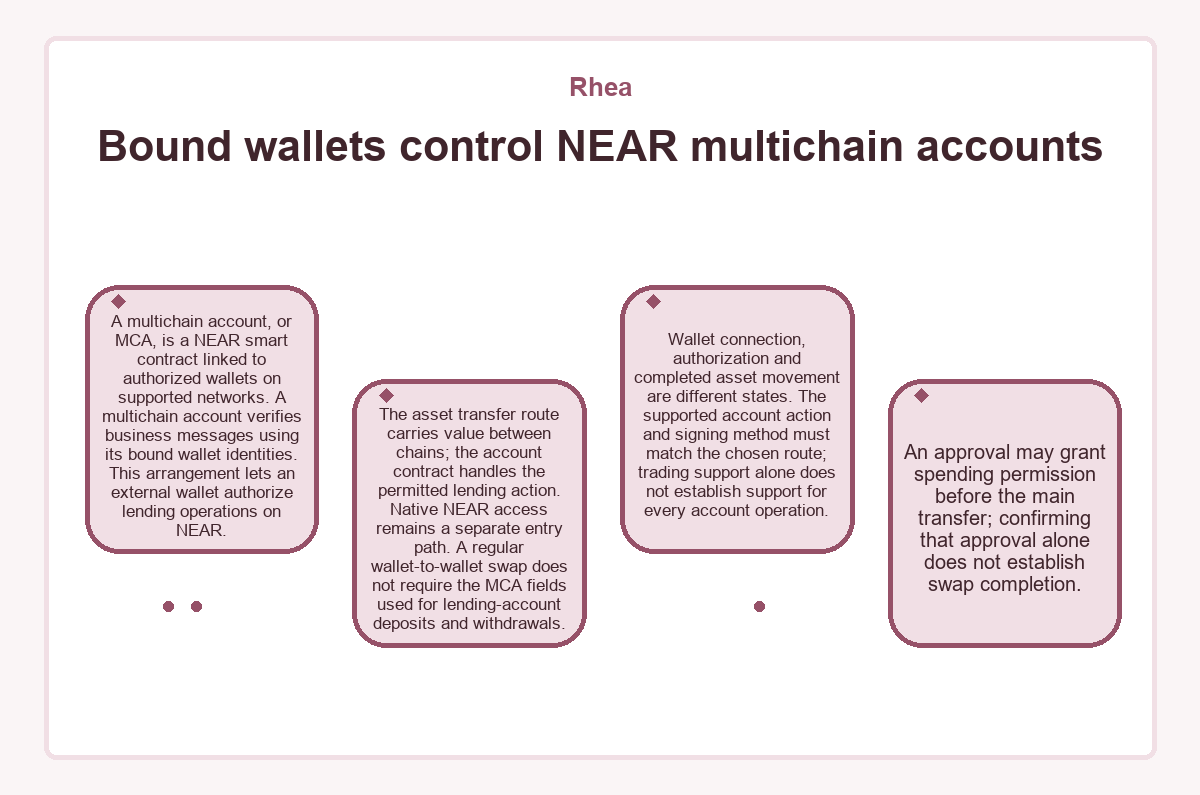
An approval may grant spending permission before the main transfer; confirming that approval alone does not establish swap completion.
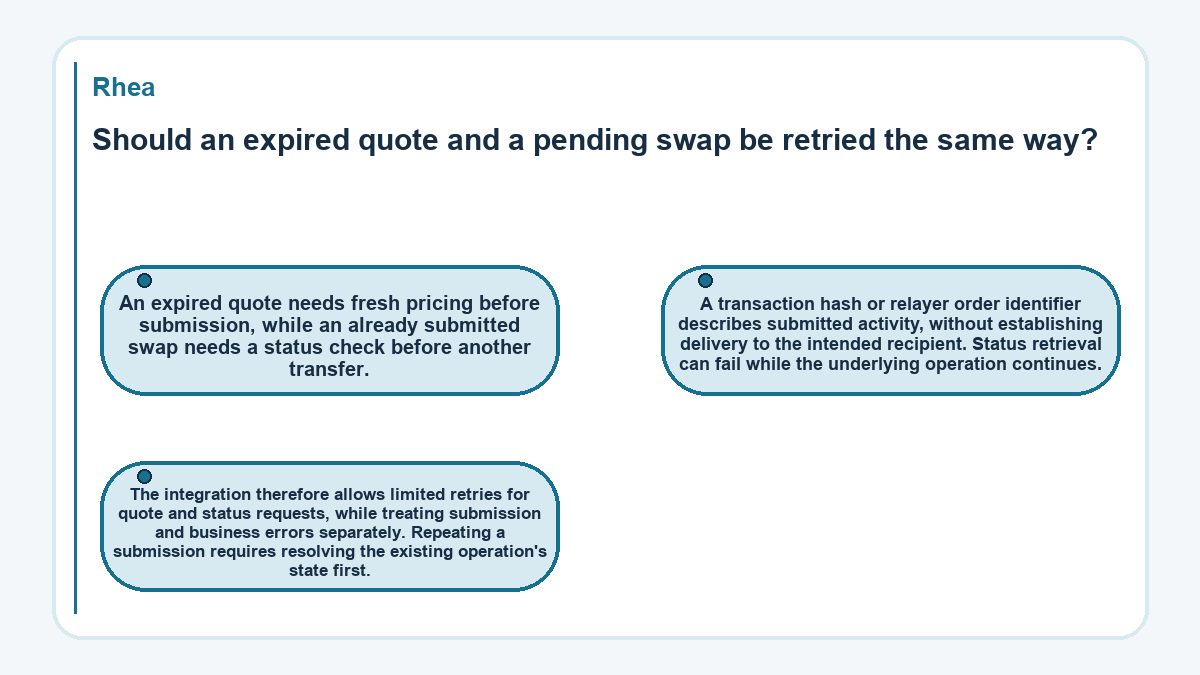
Should an expired quote and a pending swap be retried the same way?
An expired quote needs fresh pricing before submission, while an already submitted swap needs a status check before another transfer. A transaction hash or relayer order identifier describes submitted activity, without establishing delivery to the intended recipient.
Status retrieval can fail while the underlying operation continues. The integration therefore allows limited retries for quote and status requests, while treating submission and business errors separately. Repeating a submission requires resolving the existing operation's state first.
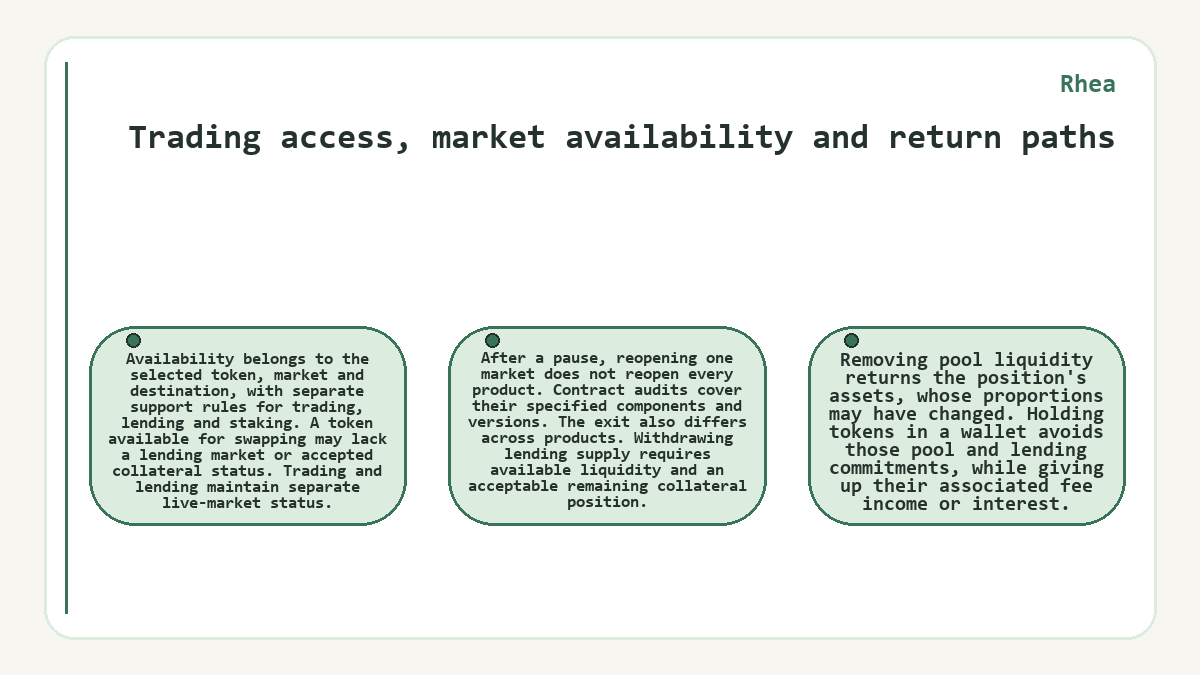
Trading access, market availability and return paths
Availability belongs to the selected token, market and destination, with separate support rules for trading, lending and staking. A token available for swapping may lack a lending market or accepted collateral status. Trading and lending maintain separate live-market status. After a pause, reopening one market does not reopen every product. Contract audits cover their specified components and versions.
The exit also differs across products. Withdrawing lending supply requires available liquidity and an acceptable remaining collateral position. Removing pool liquidity returns the position's assets, whose proportions may have changed. Holding tokens in a wallet avoids those pool and lending commitments, while giving up their associated fee income or interest.
Rhea: reader questions
Is wNEAR the same asset as rNEAR?
wNEAR is a fungible-token wrapper for NEAR, while rNEAR is a liquid-staking receipt. Wrapping changes the token representation so applications can handle it; liquid staking introduces a claim on staked NEAR. The receipt's redemption rate reflects its backing and accumulated rewards. These tokens represent different positions, even when an interface displays both alongside NEAR.
How long does standard rNEAR unstaking take?
The standard native rNEAR unstaking route normally waits about four epochs. Epoch duration follows network block production, so the wait is not a fixed number of hours. The epoch-based release condition determines when the underlying NEAR becomes withdrawable; a separate withdrawal then sends it to the wallet. Exchanging rNEAR through a pool uses a different exit mechanism, governed by available liquidity and the quoted output.
Why does a NEAR token registration request include a storage deposit?
A storage deposit reserves the on-chain space a token or application needs to record an account's balance. It is separate from transaction gas and a pool's trading fee. First use of a NEAR token contract or lending application can require registration. The required amount belongs to that contract, so there is no single registration charge for every interaction.
Can developers integrate trading without using the full website?
Developers can integrate swaps through routing interfaces and SDKs. The NEAR pool router and cross-chain swap service address different execution paths, so an application needs the matching integration. It also needs wallet handling compatible with the returned transaction or signature type. Lending operations and multichain account management use separate interfaces.
How do I access confidential swap history?
Confidential history requires a wallet-signing challenge. Before signing, confirm the challenge matches the intended wallet, network and MCA, if one is specified. Submit the resulting proof for verification; the service then issues a short-lived token to use alongside the normal API credential. Use the returned queryAddress for the history query: it identifies the authorized wallet or MCA. A normal public-history lookup does not provide the same access, and having an MCA does not itself select confidential mode.
Does Rhea ever need my recovery phrase to resolve a transfer problem?
Resolving a Rhea transfer problem does not require giving a recovery phrase or private key to another person. Those secrets grant wallet control. Unsolicited messages asking for wallet validation, a repair payment or secret credentials match impersonation scams targeting platform users. A transaction identifier provides troubleshooting context without handing over signing authority.